
Six months is the magic number.
Not because we made it up. Because the data shows it.
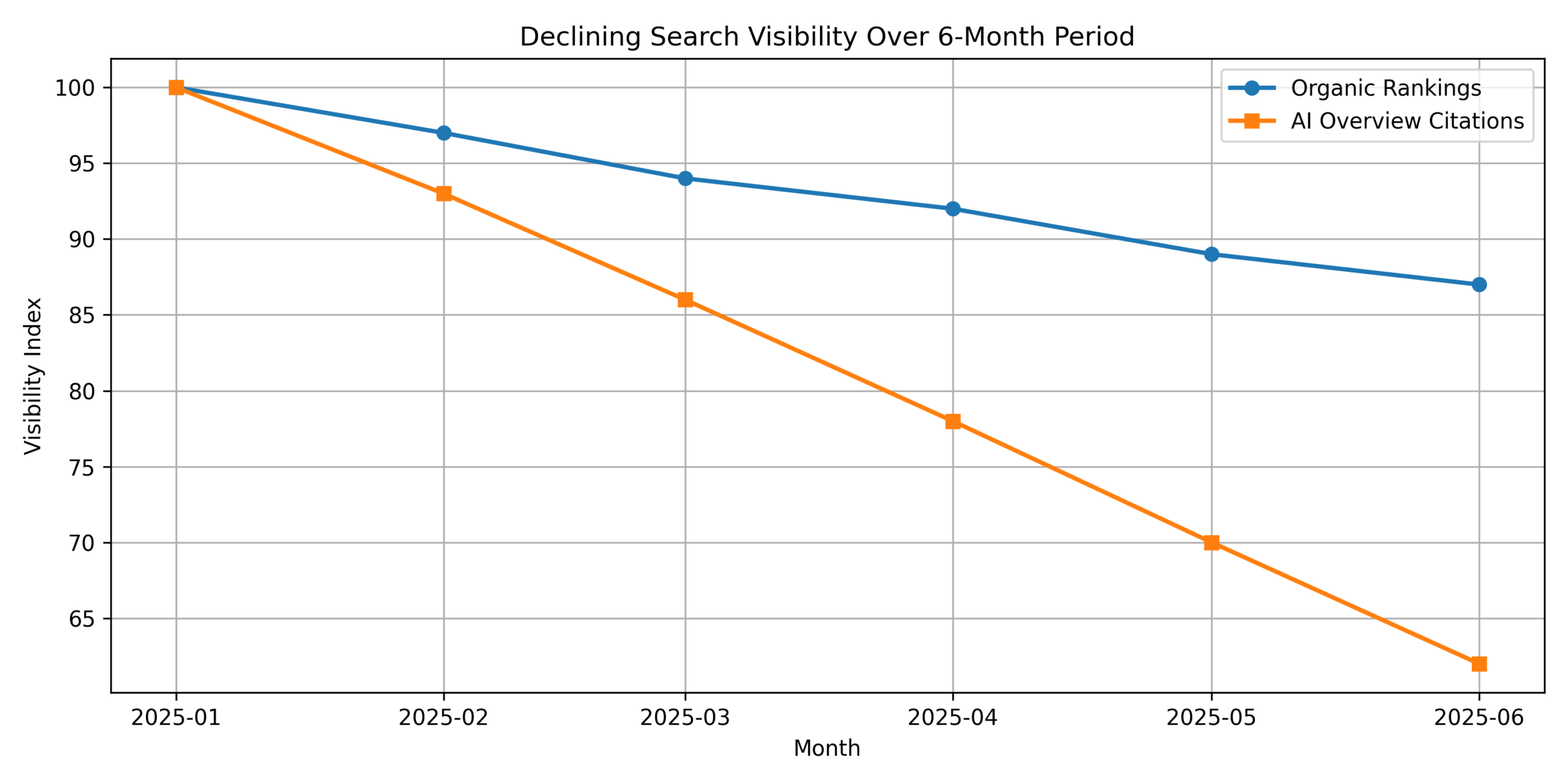
After six months of publishing nothing new, your content starts dying. Your rankings decline. Your AI Overview citations drop.
And it’s measurable.
What the Research Actually Shows
Multiple SEO studies have identified six months as the inflection point where content decay becomes reliably detectable.
Here’s what happens:
Rankings and impressions begin a gradual decline if content is not updated or added. Pages that previously performed well start showing symptoms: 6-12 month slow drops in rankings and click-through rates as newer competitors publish around the same topics.
Sites that regularly refresh or add content see more than double the organic traffic compared to those that publish rarely. The difference compounds over time.
This isn’t theory. This is what the data shows across thousands of websites.
And for attorneys? In competitive YMYL (Your Money Your Life) niches like legal, dental, and medical, the decay happens faster and hits harder.
Why Freshness Matters (More Than You Think)
Google’s “freshness” systems give extra weight to recently updated or newly published pages.
But freshness isn’t just the publish date. Google looks at:
- Update cadence (how often you refresh content)
- New information added
- Link growth
- Engagement signals
- How often content is revised to stay aligned with current search intent
Sites that systematically update existing content every 90-120 days tend to hold positions several spots higher than those that let pages sit untouched.
Six months without updates? You’re not just falling behind. You’re actively decaying.
The AI Overview Reality
Here’s where it gets worse for attorneys who go silent.
Large studies of AI search (including AI Overviews, ChatGPT, Perplexity, Gemini) show something critical:
AI-cited content is on average 25% fresher than what ranks in traditional organic search.
That’s not a small difference. That’s AI systems disproportionately pulling from recently updated pages.
What this means for attorneys:
If you stop publishing for six months, your relative “content velocity” drops to zero while competitors keep publishing. AI Overviews have a growing pool of newer, better-aligned alternatives to cite instead of your pages.
Even if you keep some long-tail organic rankings, you’re progressively less likely to appear as a cited source in AI Overviews.
Your content isn’t just getting older. It’s becoming invisible to the systems prospects actually use.
What Actually Happens After 6 Months
Based on industry studies tracking content decay and AI visibility:
Organic search impact:
- Gradual decline in rankings begins around the 6-month mark
- Pages that previously held top positions start slipping
- Click-through rates drop as you lose featured snippets and position 1-3 spots
- Competitors publishing consistently take your positions
AI Overview impact:
- Your pages fall out of AI answer citations even faster than they drop in organic rankings
- AI systems favor both authority AND recent freshness – without freshness, authority alone isn’t enough
- Brands maintaining steady content cadence attract more AI bot crawling and more frequent citations
- “Static” sites fall out of AI answers while still appearing somewhere in blue links (but prospects never scroll that far)
The compounding problem:
Content velocity isn’t absolute. It’s relative to your competitors.
If you publish nothing for six months while competitors publish 2-4 pieces per month, you’re not just standing still. You’re moving backward.
The gap widens every month you stay silent.
Why Attorneys Go Silent (The Patterns We See)
We work with attorneys. We see the same patterns repeatedly:
Pattern 1: The Motivated Launch Excited about content in January. Publishes 8 blog posts. Burns out by March. Silent for 6+ months. By the time they restart, their previous work has decayed.
Pattern 2: The Trial Spike Big trial or complex case demands full attention. Content stops. Trial ends, but they’re catching up on other work. Six months pass. Content never restarts.
Pattern 3: The DIY Burnout Tries to write everything themselves. Spends 10 hours per week writing. Realizes it’s unsustainable. Quits. Goes silent. Rankings decay while they figure out “what to do about marketing.”
Pattern 4: The Bad Hire Hires a freelance writer who doesn’t understand legal topics. Content is mediocre or wrong. Fires them. Doesn’t replace them. Six months of silence while “looking for the right writer.”
Pattern 5: The Perpetual “Later” Knows they should publish. Always something more urgent. One month becomes three becomes six. Silence becomes default. Rankings decay in the background.
All roads lead to the same outcome: measurable visibility loss in both organic search and AI Overviews.
The Real Cost
Let’s make this concrete.
Scenario: Personal injury attorney in Tampa
- Previously ranked top 3 for “personal injury attorney Tampa”
- Getting cited in AI Overviews consistently
- Estimated 3-4 qualified leads per month from organic + AI visibility
- Average case value: $25,000
After 6 months of silence:
Organic rankings drop from position 2 to position 6-8 (common decay pattern based on studies). AI Overview citations drop to near zero (competitors with fresher content get cited instead).
Qualified leads from organic + AI drop from 3-4 per month to 0-1 per month.
Lost opportunity over 6 months: 12-18 cases = $300,000-450,000 in potential case value.
And that’s assuming they restart at month 6. If silence continues to 12 months, the decay accelerates.
The consistency tax isn’t theoretical. It’s measurable revenue going to competitors who never went silent.
How Long to Rebuild
Here’s the hard truth about content decay:
It’s easier to prevent than to fix.
If you go silent for six months, you can’t just publish one new blog post and expect to bounce back.
Based on what we’ve observed working with law firms:
Getting back to previous ranking and citation levels typically requires:
- 3-6 months of consistent publishing (not sporadic)
- Updating old content that decayed during the silence period
- Publishing new content around current search intent
- Building freshness signals back into your site
And during that entire rebuilding period, competitors who never went silent are continuing to publish and pull further ahead.
The gap compounds. The longer you’re silent, the harder it is to catch up.
The Attorneys Who Never Go Silent
The attorneys maintaining strong AI Overview visibility in 2026 share one characteristic:
They never stopped publishing.
Not because they have unlimited time. Not because they’re superhuman.
Because they have systems that publish consistently whether they’re busy or not.
They’re not spending 10 hours per week writing. They’re not burning out quarterly. They’re not cycling through bad freelancers.
They have content engines that run regardless of trial schedules, case loads, or personal chaos.
Some use Voice DNA. Some have in-house teams that actually work. Some have content partners who are sustainable long-term.
The system doesn’t matter. The consistency does.
Because in 2026, the data is clear: Six months of silence triggers measurable decay in both rankings and AI citations.
The Freshness Imperative
Here’s what the research tells us about staying visible in AI Overviews:
Even adding a single 2024-2025 data point or update to an older article can significantly improve its likelihood of being pulled into AI Overviews.
That’s how sensitive AI systems are to freshness signals.
Which means:
Maintaining at least a light but consistent cadence of updates (refreshing priority pages quarterly, adding new pieces around emerging questions) is now a prerequisite to sustain AI Overview visibility.
Not an optional “extra.” A prerequisite.
Without consistent freshness signals, you decay out of AI citations even if you maintain some organic presence.
The System Question
Here’s the question that determines whether you’ll be visible in 2027:
“If I have the busiest month of my career, does my content still publish?”
If the answer is no, you don’t have a system. You have a hobby.
Hobbies get abandoned when life gets busy. Hobbies go silent for six months. Hobbies trigger content decay.
Systems don’t.
Systems publish whether you’re in trial or on vacation. Systems maintain freshness signals. Systems prevent the six-month decay window from ever starting.
Voice DNA is one version of that system. Maybe you build a different one.
But if you don’t have a system that prevents silence, you’re paying the consistency tax.
The Choice
Six months from now, you’ll be one of two attorneys:
Attorney A: Published consistently. Maintained freshness signals. Holds strong rankings. Gets cited regularly in AI Overviews. Case volume stable or growing. Content velocity matches or exceeds competitors.
Attorney B: Went silent. Content decayed over six months. Lost rankings to competitors. Fell out of AI Overview citations. Wondering why case volume dropped. Thinking about “getting back into content marketing” (again).
The data shows what happens with silence. Six months is the decay window.
Which side of that window do you want to be on?
Need a content system that prevents decay? See how Voice DNA works or schedule a strategy call.
