
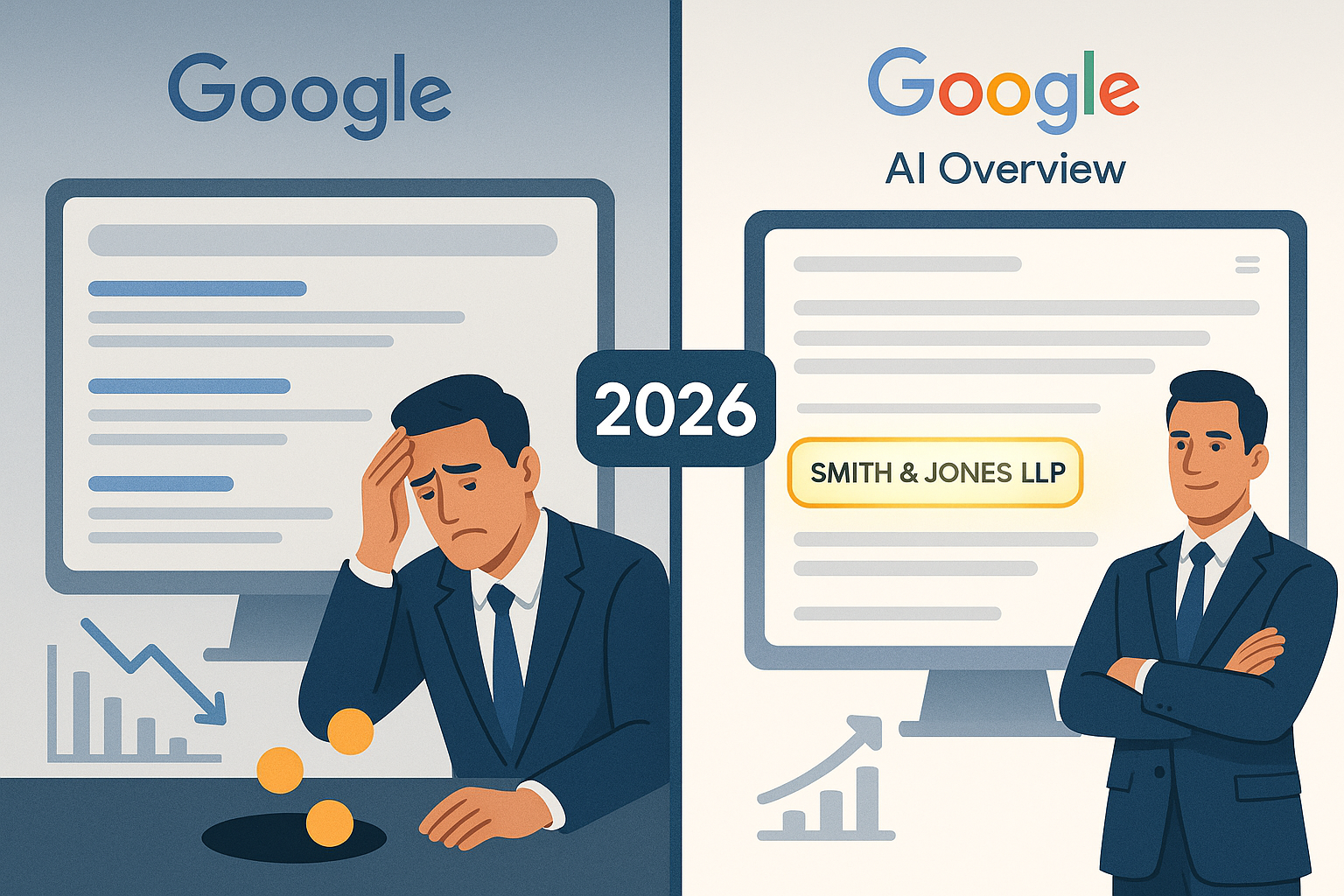
I’ve been watching the legal marketing world pretend everything is fine while the ground shifts underneath us. It’s not fine. If your firm is still treating Google like it’s 2019, you’re about to have a very expensive wake-up call.
Here’s what’s actually happening: Google now shows AI-generated answer summaries on roughly 60% of searches. For legal queries specifically, that number is growing faster than most other industries – up over 15% in the past year. And when one of those AI Overviews appears, people simply don’t click through to websites the way they used to.
The data is brutal. Zero-click searches – where the user gets their answer without visiting any website – now account for 60-70% of all Google queries. For law firms that built their entire lead generation strategy around “rank high and get the click,” this is catastrophic.
The Old Playbook Is Dead
The traditional approach was simple: rank for “divorce attorney [city]” or “estate planning lawyer near me,” get the click, convert the visitor. Agencies charged you $2,000-$5,000 a month to execute that playbook, and for a while, it worked.
But here’s what’s happening now: someone searches “what should I do about probate in Texas,” and Google’s AI Overview gives them a solid answer right on the search results page. They never click your website. They never fill out your contact form. Your ranking doesn’t matter if nobody sees it.
Multiple studies in 2025 show that when AI summaries appear, users are significantly less likely to click through – even to top-ranked results. On mobile, the AI Overview plus featured snippets can take up the entire first screen, pushing your carefully-optimized listing so far down that it might as well not exist.
But Here’s the Opportunity
The firms that are adapting aren’t trying to fight AI search. They’re getting cited IN the AI Overview itself.
Think about what that means: when Google’s AI quotes your firm directly in its answer, you get a branded mention with implied Google endorsement, visible to everyone who searches that term. That’s better than ranking #1 used to be.
So how do you become the source that AI systems cite?
What Actually Works Now
The research is pretty consistent on what triggers AI Overview citations:
- Deep topical authority – not thin pages targeting keywords, but comprehensive content that demonstrates actual expertise in your practice area
- Strong E-E-A-T signals – Google’s systems look for Experience, Expertise, Authoritativeness, and Trustworthiness. For attorneys, that means content that sounds like it was written by an actual lawyer, not a content mill
- Local expertise – specific knowledge about your city, jurisdiction, local courts, and regional legal nuances
- Structured, current content – up-to-date information, proper schema markup, clear FAQ formats that AI systems can parse
- Authentic voice – this is the one most agencies miss completely. Google’s AI can detect generic, obviously-AI-generated content, and it filters it out
The Problem Most Agencies Can’t Solve
Here’s where it gets tricky: you need content that’s comprehensive enough to establish topical authority, localized enough to show genuine expertise, and authentic enough to pass as written by an actual attorney.
Most agencies are still pumping out generic SEO content that’s obviously written by someone who’s never practiced law and knows nothing about your city. Google’s AI systems are increasingly good at ignoring that stuff.
How We’re Solving the Authenticity Problem
This is exactly why we developed Voice DNA technology. Instead of guessing at what makes content sound authentic, we analyze actual attorney writing across 13 different dimensions – everything from sentence structure and vocabulary to how you explain complex legal concepts and address client concerns.
The result is content that doesn’t just avoid AI detection patterns. It genuinely reads like the attorney wrote it, because it’s built on that attorney’s actual communication DNA.
When Google’s AI systems evaluate your content for expertise and authoritativeness, they’re not just looking at keywords. They’re analyzing whether this sounds like someone who actually practices law or someone who read a Wikipedia article. Voice DNA solves that problem at scale.
The Local Expertise Gap
But authentic voice is only half the equation. The other half is genuine local knowledge.
This is where most “local SEO” completely falls apart. Agencies create city pages by swapping out the city name in a template. Google’s not stupid. Neither are your potential clients.
Our City Intelligence process goes deeper. Before we write a single word about estate planning in Austin or personal injury law in Phoenix, we research:
- Local court systems and procedures
- Regional legal nuances and jurisdiction-specific considerations
- Community demographics and concerns
- Local economic factors that impact legal needs
- Competing firms and market positioning
Then we combine that City Intelligence with the attorney’s Voice DNA to create content that genuinely sounds like a local expert wrote it. Because effectively, they did – we just systematized the process.
What This Means for Your Lead Generation
The experts are clear on this: firms that depend entirely on “SEO + Google Ads” are going to struggle in 2026. The winning approach combines:
- AI-aware content strategy that gets you cited in AI Overviews
- Strong Google Business Profile optimization for local searches
- Alternative lead channels (email, remarketing, referral networks) that aren’t dependent on search clicks
- Faster, smarter intake processes for the qualified leads who do click through
Some firms are already seeing this pattern: fewer total website visits, but higher conversion rates because the people who DO visit are further along in their decision-making process.
The Bottom Line
The shift from “get the click” to “own the answer” is permanent. AI search isn’t going away. The penetration rate is only going to increase as Google rolls this out more aggressively.
By mid-2026, the firms that treated this as a temporary blip will be scrambling. The firms that adapted their content strategy now will own their markets.
The question isn’t whether AI search is coming to your practice area. It’s whether you’ll be the firm that AI systems cite as the authority, or the firm that gets buried below the fold while your competitors get quoted above it.
The difference comes down to two things: authentic attorney voice and genuine local expertise. Everything else is just window dressing.
