
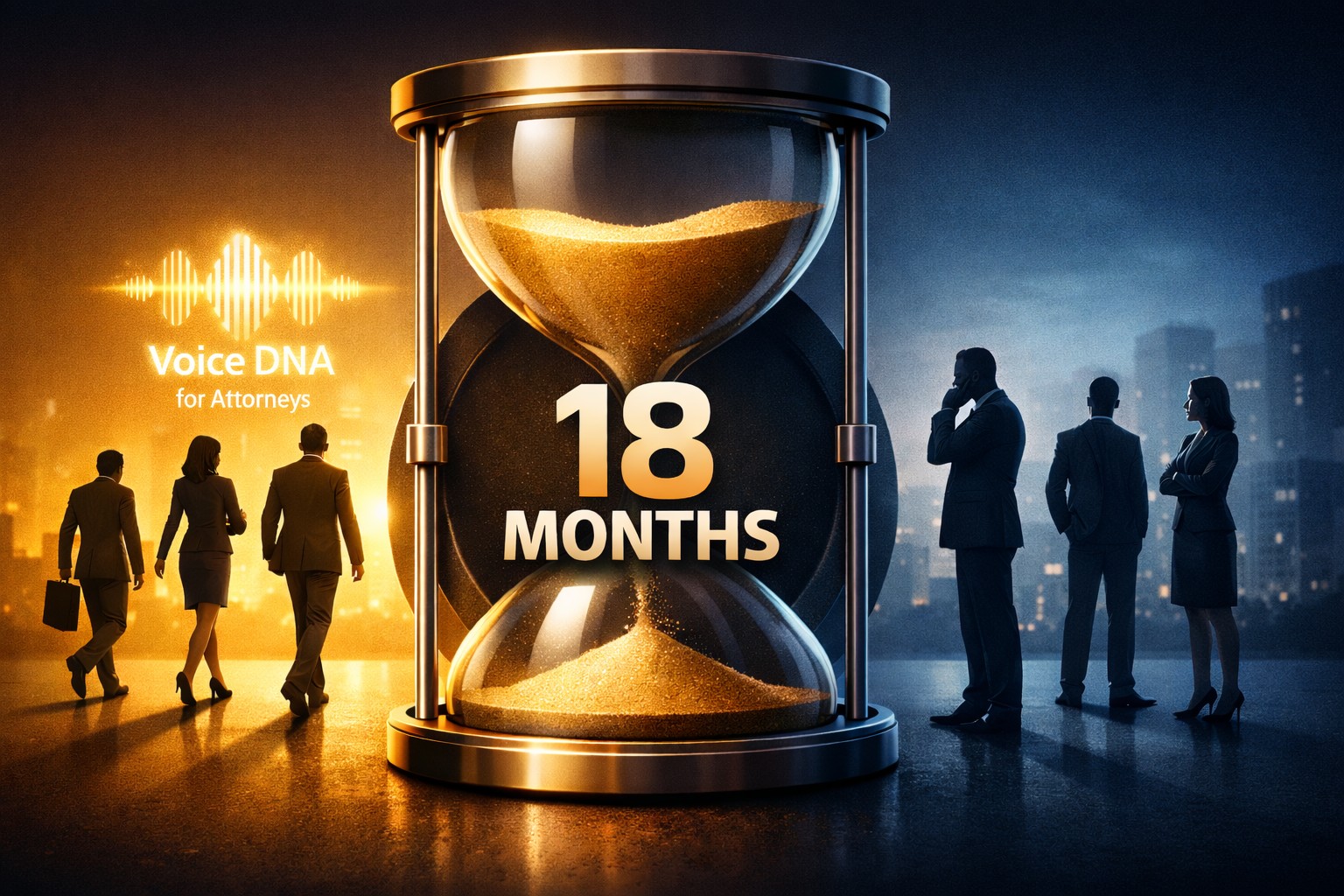
We just filed to trademark Voice DNA for Attorneys. Here’s why that matters more than you think.
What Just Happened
On December 19, 2025, we filed a trademark application for “Voice DNA for Attorneys” with the USPTO.
Most people will read that and think: “Okay, so you’re trademarking your service name. Cool.”
They’re missing what actually happened.
We didn’t just file paperwork for a service.
We’re claiming a category.
Why We Did It
For the past year, we’ve been watching something unfold that most legal marketing agencies haven’t noticed yet.
AI Overviews launched. Google’s AI now reads your content, decides if it’s citation-worthy, and either promotes you to the top or ignores you completely.
The attorneys getting cited? They have one thing in common.
Their content sounds like they actually wrote it.
Not like their marketing agency wrote it. Not like ChatGPT wrote it. Like they wrote it.
The problem: most attorneys don’t have time to write content themselves.
So they hire agencies. Or they use ChatGPT. And they end up with content that sounds like every other attorney in their practice area.
Generic content doesn’t get cited in AI Overviews.
This created a problem nobody had solved: How do you create content that sounds authentically like a specific attorney, at scale?
That’s what we built Voice DNA to do.
What Voice DNA Actually Is
We spent over 1,000 hours developing a system that extracts the linguistic patterns from an attorney’s writing and replicates them.
Not their “tone.” Not their “style.”
Their actual voice.
When we show an attorney their Voice DNA output for the first time, the reaction is always the same:
“Wait… this sounds exactly like me. How did you do that?”
We analyze their existing writing across multiple dimensions:
- Sentence length distribution
- Vocabulary patterns
- How they structure arguments
- How they open and close paragraphs
- The specific phrases they use
- How they ask questions
- Their punctuation habits
Then we create content that matches those patterns.
The result: Content that sounds like the attorney wrote it, because it’s built from how that attorney actually writes.
Why This Changes Everything
Right now, there’s a 12-18 month window where most attorneys haven’t figured out what’s happening.
They’re still writing keyword-stuffed content for traditional SEO.
They’re still using ChatGPT and wondering why it sounds generic.
They’re still hiring agencies that produce content that could be from any law firm.
And AI Overviews are ignoring all of it.
Meanwhile, the attorneys who sound distinctive—who sound like themselves—are getting cited.
They’re showing up in AI Overview recommendations.
They’re getting the visibility.
They’re getting the clients.
The Window Is Closing
Here’s what’s going to happen over the next 18 months:
Months 1-6:
- More attorneys notice their generic content isn’t working
- They start looking for solutions
- A few find Voice DNA and see results
- Word spreads in legal circles
Months 6-12:
- Competitors realize there’s demand for voice replication
- They try to build their own versions
- But they can’t use “Voice DNA” (we filed the trademark)
- They use inferior terminology: “voice matching,” “voice cloning,” “voice replication”
Months 12-18:
- Voice DNA becomes the recognized term in legal marketing
- Attorneys either use it or use something that claims to do what it does
- Early adopters have 12-18 months of market advantage
After 18 months:
- This becomes table stakes
- Everyone either has authentic voice replication or they’re invisible
- But the attorneys who moved early own their market position
Why Timing Matters
If you’re an attorney reading this, you have a choice:
Move now:
- Be among the first with content that sounds authentically like you
- Get cited in AI Overviews while your competitors are still figuring it out
- Build authority in your market before everyone else catches up
Move later:
- Watch competitors get cited while your content gets ignored
- Scramble to catch up when everyone realizes this matters
- Compete on price because you have no differentiation
The difference is 12-18 months of market advantage.
What Early Adopters Get
The attorneys working with Voice DNA right now are seeing something their competitors aren’t:
AI Overviews citing their content. Not their competitors. Them.
Because their content sounds like an actual expert wrote it. Because it’s distinctive. Because it’s authentic.
When Google’s AI reads 50 personal injury attorneys’ content about car accidents and 49 of them sound identical…
It cites the one that sounds different.
That’s the attorney who gets the visibility.
That’s the attorney who gets the client.
Why We Filed The Trademark
We filed for “Voice DNA for Attorneys” because we built something that didn’t exist before.
Not a better content service.
A different approach entirely.
We’re not writing better generic content.
We’re replicating specific voices.
That’s a category difference.
And we want to own that category.
Over the next 6-12 months, the USPTO will review our application. If approved, we’ll have legal protection for the term.
But the real protection isn’t legal.
It’s the 1,000+ hours we invested building this system.
Competitors can try to copy the idea. They can’t copy the methodology we developed.
They’re 1,000 hours behind.
By the time they catch up, we’ll be 2,000 hours ahead.
And Here’s The Thing About Voice DNA…
Attorneys were our proving ground.
They have the most demanding requirements:
- Bar compliance (can’t sound like AI)
- Complex subject matter (AI usually fails)
- Personal credibility matters (generic = death)
- Content directly drives business (get cited = get hired)
If Voice DNA works for attorneys, it works for anyone.
Doctors who need authentic patient education content.
Financial advisors who need compliant thought leadership.
Consultants who need to sound like experts, not like ChatGPT.
Voice DNA isn’t just for attorneys.
It’s for every knowledge professional who needs content that sounds like them.
We’re starting with attorneys because the pain is most acute here.
But this methodology works for any profession where personal voice and credibility matter.
More on that soon.
What Happens Next
Over the next 18 months, you’re going to see one of two things happen in your market:
Scenario A:
- A competitor starts getting cited in AI Overviews
- Their content sounds distinctive and authoritative
- You notice they’re getting visibility you’re not
- You scramble to figure out what they’re doing differently
- By the time you catch up, they own the market position
Scenario B:
- You move first
- Your content gets cited while competitors are still using generic ChatGPT output
- You build 12-18 months of authority and visibility
- When competitors finally figure it out, you’re already established
The Bottom Line
In 18 months, every attorney will either:
- Be using Voice DNA (or trying to)
- Be using something that claims to do what Voice DNA does
- Be invisible in AI Overviews because their content sounds generic
The question isn’t whether voice replication becomes standard.
The question is: Are you early or late?
See What Your Content Actually Sounds Like
We’re offering free Voice DNA audits to attorneys who want to see the difference.
We’ll take a sample of your writing and show you what Voice DNA-generated content looks like compared to what you’re publishing now.
No obligation. No sales pitch. Just a direct comparison.
Contact us at contact@smartchimp.ai to request your free audit.
