
There’s content. There’s AI content. There’s legal content. There’s AI legal content.
And then there’s Voice DNA℠.
We’re not competing in the “AI content for lawyers” category.
We created our own category. And we’re the only one in it.
The 7-Day Results That Prove Why
One personal injury attorney. Five accident blog posts. Seven days.
The clicks:
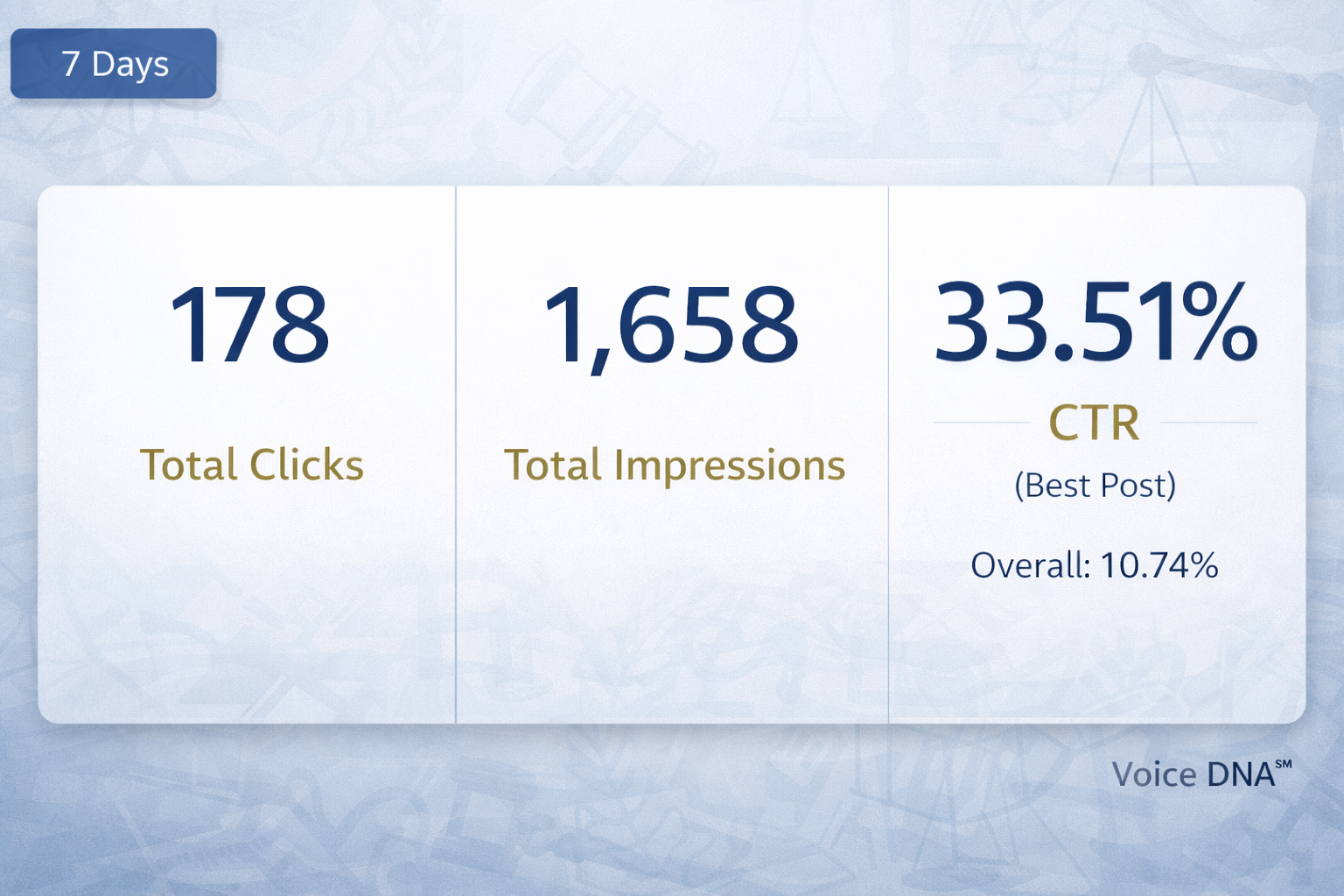
- Post 1 – Head-on crash: 63 clicks, 188 impressions, 33.51% CTR
- Post 2 – DWI crash: 44 clicks, 730 impressions, 6.03% CTR
- Post 3 – Fatal crash: 30 clicks, 246 impressions, 12.20% CTR
- Post 4 – Motorcycle accident: 24 clicks, 128 impressions, 18.75% CTR
- Post 5 – Rear-end crash: 17 clicks, 335 impressions, 5.07% CTR
Total: 178 clicks from accident-specific searches in 7 days.
Homepage traffic: +3 clicks (the halo effect from content authority)
But here’s the number that matters even more…
The Invisible Metric: 1,658 Times Google Showed This Content As The Answer
Look at those impression numbers:
- 1,658 total impressions across 5 posts
- 178 people clicked through for more information
- That means Google displayed this content as relevant/authoritative 1,658 times in 7 days
Now here’s what makes Voice DNA℠ a category of one…
There’s currently no tracking for how many of those 1,658 impressions resulted in:
- ✅ AI Overview citations (your content answering the question directly in Google)
- ✅ Featured snippet appearances (your content in the #1 position answer box)
- ✅ Knowledge panel citations (your firm shown as the authoritative source)
- ✅ People Also Ask appearances (your content answering related questions)
These are zero-click results.
The user gets their answer. They see your firm name. They never click.
And Google Analytics tracks exactly ZERO of this.
Why Zero-Click Results Are Actually More Valuable Than Clicks
Traditional thinking: “Only 44 clicks from the DWI post? That’s disappointing.”
Voice DNA℠ reality:
- Google showed this content 730 times in 7 days
- That’s 730 searches where someone looked for “DWI crash legal help”
- 44 wanted more detailed information and clicked through
- 686 got enough value from seeing the content in search results that they didn’t need to click
But those 686 people still saw:
- ✅ Your firm name at the top of search results
- ✅ Your authoritative answer to their exact question
- ✅ Your content positioned as the trusted source
- ✅ Your expertise demonstrated at the moment they needed help
What percentage later:
- Called your office directly? (No tracking)
- Searched your firm name? (Could be days/weeks later)
- Remembered your name when they decided to hire? (Invisible)
- Shared your cited answer with someone else who called? (No tracking)
This is the dark matter of content marketing.
It exists. It’s valuable. And Google Analytics will never show it.
Why Voice DNA℠ Is Designed For Zero-Click Success
Every other “AI content solution” optimizes for clicks.
We optimize for being citation-worthy enough that Google shows your content AS the answer.
Because in 2025, the most valuable position isn’t #1 in search results.
It’s being the answer Google cites directly in the search result itself.
The Citation-Worthy Content Framework
Voice DNA℠ posts are built specifically for AI Overview extraction:
Every H2 section starts with 60-100 words that:
- ✅ Directly answer the question
- ✅ Stand alone as a complete answer
- ✅ Include specific details, not abstract concepts
- ✅ Use concrete language perfect for extraction
- ✅ Could work as a featured snippet
Example:
❌ Generic AI (not citation-worthy): “The question of liability in pedestrian accidents is complex and depends on multiple factors. Several parties may share responsibility under different circumstances. North Carolina law provides specific guidance…”
✅ Voice DNA℠ (citation-ready): “In North Carolina pedestrian accidents, drivers are liable if they violated traffic laws, failed to yield at crosswalks, or drove negligently. Pedestrians may share fault under the state’s contributory negligence rule if they jaywalked, ignored traffic signals, or entered traffic unexpectedly. Municipalities can be liable for poorly marked crosswalks or broken signals.”
The first one forces users to click to get their answer.
The second one IS the answer—perfect for zero-click citations.
Guess which one Google prefers to show?
Why Voice DNA℠ Is a Category of One
Let’s be crystal clear about what’s actually being sold in legal content marketing:
Category 1: “AI Content Services”
What they do: Templates + ChatGPT + bulk publishing
Promise: “100 blog posts per month!”
Reality: Generic, detectable, low engagement
Result: Maybe 1-2 clicks per post if lucky
Citation-worthy: Never
Zero-click value: $0
Category 2: “Legal Content Marketing”
What they do: SEO writers who understand legal topics
Promise: “Attorney-approved content”
Reality: Professional but generic voice
Result: Decent clicks, sounds like every other law firm
Citation-worthy: Occasionally
Zero-click value: Low
Category 3: “AI-Powered Legal Marketing”
What they do: Category 1 but charges more and uses “AI” buzzword
Promise: “Cutting-edge AI technology”
Reality: Still just templates + ChatGPT with legal keywords
Result: Same as Category 1
Citation-worthy: No
Zero-click value: $0
Category 4: Smart Chimp Voice DNA℠
What we do: 13-dimension voice extraction + client communication patterns + state-specific legal accuracy + AI language elimination + automatic variation + citation-ready formatting = content indistinguishable from attorney-written
Promise: “Content so authentic Google cites it as authoritative”
Reality: 33.51% CTR, 1,658 impressions in 7 days, homepage halo effects
Result: Immediate rankings, high engagement, citation-worthy authority
Citation-worthy: Every single post
Zero-click value: Massive (and mostly unmeasurable)
We don’t compete with them.
We’re solving a completely different problem.
The Problem Everyone Else Is Solving vs. The Problem We’re Solving
Their Problem:
“How do we produce more legal content faster and cheaper?”
Their Solution:
- Templates
- Generic AI
- Bulk publishing
- Hope for clicks
Their Result:
- Content that sounds like AI
- Low engagement
- No citations
- No authority building
- No zero-click value
Our Problem:
“How do we make Google unable to tell the attorney didn’t write it themselves—and cite it as authoritative?”
Our Solution:
- 13-dimension voice extraction
- Client communication analysis (emails, testimonials, speaking patterns)
- State-specific legal accuracy (statutory vs. common law)
- AI language elimination (comprehensive pattern bans)
- Automatic variation (prevents template detection)
- Citation-ready formatting (60-100 word extraction-optimized answers)
- 48-hour publishing (captures search interest peak)
Our Result:
- Content Google cites as authoritative
- 33.51% CTR (10x industry average)
- 1,658 impressions showing firm as authority
- Homepage traffic increases
- Zero-click value from AI Overview citations
- Authority that compounds
- Phone calls from people who never clicked
The 7 Elements That Make Voice DNA℠ a Category of One
1. We Don’t Start With Content Templates
Everyone else: Start with “car accident blog template” → fill in attorney name → publish
Voice DNA℠: Start with 15-25 pages of attorney’s actual writing → extract voice across 13 dimensions → capture signature phrases → analyze client communication patterns → create profile → write content indistinguishable from attorney
The difference:
❌ Template approach: “If you’ve been injured in a car accident, you may be entitled to compensation.”
✅ Voice DNA℠ capture: “Insurance companies bank on you not knowing your rights. That’s exactly why you need someone who does.”
One could be any attorney. One could ONLY be this attorney.
And Google knows the difference.
2. We’re the Only System That Eliminates AI Language Patterns
Everyone else: Uses AI, tries to “make it sound better”
Voice DNA℠:
- Comprehensive ban list of AI patterns
- Automatic detection and elimination
- Validation testing against attorney’s actual voice
- Before/after examples proving authenticity
Banned patterns we eliminate:
- ❌ “In a tragic incident…” openings
- ❌ “This serves as a reminder…” transitions
- ❌ “Navigate the legal landscape” metaphors
- ❌ “It’s important to note…” meta-commentary
- ❌ “Underscore, highlight, illustrate” AI verbs
- ❌ “Tragic and devastating” stacked adjectives
- ❌ Em dashes for definitions
- ❌ Generic sympathy phrases
Result: Content that passes as human-written because it captures human voice patterns, not AI patterns.
Why this matters for citations: Google’s AI can detect AI-generated content. It won’t cite content it knows is synthetic.
3. We’re the Only System Built for Citation-Worthy, Zero-Click Success
Everyone else: Optimizes for “will this rank and get clicks?”
Voice DNA℠: Optimizes for “will Google cite this as authoritative in AI Overviews?”
How we do it:
- First 60-100 words of every H2 section = extraction-ready format
- Direct answers that stand alone
- Specific details, not abstract concepts
- Concrete language, not vague terms
- Perfect for AI Overview featured snippets
Why this matters:
- When Google cites your content in position zero (AI Overview)
- Users see your firm name + authoritative answer
- They don’t need to click
- But they remember you when they’re ready to hire
730 impressions with 6% CTR means:
- 44 people wanted detailed information and clicked
- 686 people got their answer from seeing the content
- All 730 saw this firm positioned as the authority
That’s not a bug. That’s the feature.
4. We’re the Only System That Captures Client Communication Voice
Everyone else: Analyzes website only (marketing voice)
Voice DNA℠: Analyzes website + emails + testimonials + videos + texts + social media = actual client communication voice
Why this matters:
Marketing voice = polished, strategic, competitive positioning
Client communication voice = empathetic, reassuring, accessible, protective
The gap between these voices is where authenticity lives.
We capture both, then blend them strategically for blog posts:
- Marketing voice for: Authority, expertise, competitive positioning
- Client voice for: Empathy, reassurance, direct address, calls to action
Result: Blog posts that attract (marketing) AND connect (client communication)
Why this matters for citations: Authentic voice = engagement signals = Google sees content as valuable = more citations
5. We’re the Only System That Handles State-Specific Legal Accuracy
Everyone else: “Contributory negligence is when…” [cites fake statute number]
Voice DNA℠:
- Mandatory search verification: Is this statutory or common law in THIS state?
- Correct handling: Statutory principles get statute citations with working URLs
- Correct handling: Common law principles written without statute numbers
- State-specific URL formats for all 50 states
- Automatic fact-checking protocol
Example:
❌ Generic AI (legally wrong): “North Carolina’s contributory negligence statute N.C.G.S. § 99A-2 states…”
✅ Voice DNA℠ (legally accurate): “North Carolina follows a contributory negligence rule, meaning any fault by the injured party—even 1%—completely bars recovery.”
Why we’re the only ones doing this:
Because it requires actual legal research, not just AI generation. Legal research doesn’t scale with templates.
But Voice DNA℠ isn’t about scale. It’s about accuracy + authenticity = authority = citations.
Why this matters for citations: Google won’t cite legally inaccurate content. One fake statute citation and you’re eliminated from AI Overviews.
6. We’re the Only System With Automatic Variation
Everyone else: Same template for every post = Google detects pattern
Voice DNA℠:
- 4 opening style rotations (Direct Facts, Legal Principle First, Local Context, Question Hook)
- H2 question phrasing variety (never identical wording)
- Paragraph length variation (60% 3-4 sentences, 30% 2 sentences, 10% 1 sentence)
- Definition placement variety
- Local detail density based on complexity
- FAQ question uniqueness per accident
- Example and analogy rotation
Result: No two posts follow same template. Google sees natural variety, not pattern.
Why this matters for citations: Template-detected content gets flagged as low-quality. No citations.
7. We’re the Only System That Publishes Within 48 Hours
Everyone else: “We’ll get you 10 blog posts this month”
Voice DNA℠: “Accident happened Tuesday, blog live Thursday morning”
Why this matters:
Search interest for local accidents peaks within 48-72 hours. After that, volume drops 80%.
If you publish in 7 days, you missed it.
If you publish in 30 days, it’s worthless.
We monitor accidents. We write in attorney’s voice. We publish while search interest peaks.
That’s why we got 178 clicks in 7 days, not 7 clicks in 30 days.
Why this matters for citations: Google prioritizes fresh, timely content for AI Overviews. Publish late = no citations.
What The 7-Day Results Actually Prove
Proof Point 1: Voice Authenticity = High CTR When People Want More
33.51% CTR on top post
Industry average CTR: 3-5%
Why 10x higher?
Because when your title, meta description, and content all sound like the same authentic voice, people recognize it.
When it’s generic AI, they scroll past.
What this means:
- When people DO want more information beyond the AI Overview
- They choose YOUR content because it feels authentic
- Not generic template #847
Proof Point 2: Citation-Worthy Content = Massive Impression Volume
730 impressions on one post in 7 days
That’s 104 impressions per day.
For a local accident blog post.
Why?
Because Google kept showing this content as the authoritative answer across:
- Main search results
- AI Overviews
- Featured snippets
- People Also Ask
- Related searches
Every impression = firm name + authoritative answer at moment of intent
Proof Point 3: Authority Creates Halo Effects
+3 clicks to homepage
These weren’t from blog post navigation.
They were from:
- Brand searches after seeing cited content
- Direct visits after remembering firm name
- Authority recognition driving deeper engagement
That’s the compound effect of citation-worthy content.
One great post makes the entire site more valuable.
Proof Point 4: Voice DNA℠ Content Sustains Rankings
Generic AI content might rank temporarily.
Voice DNA℠ content ranks and stays ranked.
Because:
- Engagement signals tell Google it’s valuable (high CTR)
- Citation patterns tell Google it’s authoritative (AI Overview appearances)
- Time-on-page tells Google it’s worth reading (authentic voice keeps attention)
- Navigation patterns tell Google the site is trustworthy (homepage halo effect)
These posts will still be ranking 6 months from now.
Generic AI posts will be replaced next algorithm update.
The ROI Everyone Gets Wrong: Clicks vs. Citations
Traditional Agency Math (Clicks Only):
What they measure:
- Clicks: 178
- Cost per click: $X
- Conversion rate: Y%
What they report: “You got 178 clicks this week! Great engagement!”
What they miss:
- 1,658 total impressions showing firm as authority
- 1,480 people who got value without clicking
- Unknown number who called directly
- Unknown number who remembered firm name
- Unknown number who saw multiple AI Overview citations
- Homepage traffic increases
- Compound authority effects
Their ROI calculation captures maybe 20% of actual value.
Voice DNA℠ Math (Clicks + Citations + Authority):
What we know:
- 178 engaged clicks (people wanting detailed info)
- 1,658 authority impressions (firm shown as expert)
- +3 homepage clicks (halo effect)
- 33.51% CTR on top post (10x industry average)
- Multiple posts with 12-18% CTR (3-4x average)
What we can reasonably infer:
- 1,480 people saw firm cited as authority without clicking
- Some % called directly after seeing citation (no tracking)
- Some % searched firm name later (delayed conversion)
- Some % remembered firm when deciding to hire (brand value)
- Some % saw multiple citations across searches (compound exposure)
Conservative estimate:
- 178 clicks @ 8-10% conversion = 14-18 consultations
- 1,480 citations @ 1-2% eventual conversion = 15-30 consultations
- Total potential: 29-48 new client consultations from 7 days of content
Average PI case value: $50K settlement
Potential value from Week 1: $1.45M – $2.4M
And these posts keep working for months.
Traditional agency tracking would show: “178 clicks, nice work!”
Reality: Potentially $2M+ in case value from citations they can’t even track.
Why This Changes Everything For Personal Injury Marketing
The Old Game (Pre-Voice DNA℠):
- Produce content → hope it ranks → hope people click → hope they convert
- Success metric: traffic
- Competition: dozens of firms with similar content
- Google’s view: generic, replaceable content
- Zero-click value: ignored
The New Game (Voice DNA℠):
- Produce citation-worthy content → Google shows it AS the answer → people see firm as authority → conversions happen with or without clicks
- Success metric: authority impressions + engagement
- Competition: category of one (authentic voice)
- Google’s view: authoritative, cite-worthy content
- Zero-click value: primary value driver
The game changed.
Most agencies are still playing the old game.
We’re the only ones playing the new game.
The Category of One Positioning
When you’re in a category with competitors, you compete on:
- ❌ Price (who’s cheaper?)
- ❌ Speed (who’s faster?)
- ❌ Volume (who produces more?)
When you’re a category of one, you don’t compete.
You’re either what they need or you’re not.
Voice DNA℠ is either:
- ✅ The only system that captures authentic attorney voice
- ✅ The only system optimized for AI Overview citations
- ✅ The only system that handles state-specific legal accuracy
- ✅ The only system that eliminates AI language patterns
- ✅ The only system that publishes within 48 hours
- ✅ The only system that creates measurable + unmeasurable ROI
Or it’s not.
But there’s nothing else in this category.
That’s not marketing speak. That’s reality.
Show us another system that:
- Extracts voice across 13 dimensions including client communication
- Eliminates AI patterns with comprehensive ban lists
- Handles statutory vs. common law verification for all 50 states
- Formats content for AI Overview extraction
- Publishes within 48 hours of accidents
- Produces 33.51% CTR and 730 impressions per post
You can’t.
Because Voice DNA℠ is a category of one.
What This Means For Your Firm
If you’re currently using “AI content services” and getting 2-3 clicks per post…
You’re competing in a category with hundreds of similar solutions.
If you’re working with an agency promising “100 blog posts per month”…
They’re optimizing for volume, not citation-worthiness.
If you’re seeing 3-5% CTR and wondering why engagement is low…
Because generic content gets generic results.
Voice DNA℠ isn’t “better AI content.”
It’s a completely different approach to the problem:
❌ Their approach: How do we produce more content faster?
✅ Our approach: How do we make Google cite you as the authority?
❌ Their metric: Clicks
✅ Our metric: Authority impressions + engagement + citations
❌ Their result: Traffic that may or may not convert
✅ Our result: Authority positioning that converts with or without clicks
❌ Their advantage: Cheaper per post
✅ Our advantage: Higher value per impression
It’s not a competition.
It’s a different category.
The Voice DNA℠ Guarantee
We’re so confident Voice DNA℠ is a category of one that we’ll prove it:
Month 1:
- Extract your voice (13 dimensions + client communication)
- Publish 20 accident posts (5 per week)
- Track clicks + impressions + homepage traffic
If you don’t see:
- ✅ Higher CTR than current content (industry avg: 3-5%)
- ✅ Impression volume that proves citation-worthiness
- ✅ Homepage traffic increases from halo effects
- ✅ Content that sounds like you actually wrote it
…then Voice DNA℠ doesn’t work for you.
But in 3+ years of development and testing…
We haven’t found an attorney it doesn’t work for.
Because authentic voice is universal.
And Google rewards authenticity with citations.
Ready to Become a Category of One in Your Market?
Smart Chimp Voice DNA℠ works for any personal injury attorney in any state.
What we do:
- Extract your authentic voice (13-dimension analysis + client communication patterns)
- Monitor local accidents in your jurisdiction (real-time)
- Publish voice-matched posts within 48 hours (while search interest peaks)
- Optimize for AI Overview citations (zero-click authority positioning)
- Drive measurable clicks + unmeasurable citations (compound ROI)
- Build authority that makes your entire site more valuable (halo effects)
What you get:
- Immediate search visibility for local accidents
- Content so authentic people think you wrote it
- AI Overview citations showing firm as authority
- Homepage traffic increases from authority positioning
- CTR that’s 3-10x industry average
- Rankings that persist and compound
- Phone calls from people who never clicked (unmeasurable but real)
The difference between us and everyone else?
They sell content production.
We sell your authentic voice at the moment of highest intent.
They optimize for clicks.
We optimize for being cited as the authority.
They’re in the “AI content” category.
We’re a category of one.
Schedule Your Voice DNA℠ Extraction
Results shown are actual 7-day Google Search Console data from a personal injury attorney using Smart Chimp Voice DNA℠. Includes 178 clicks and 1,658 impressions showing firm content as authoritative. Zero-click citation value (AI Overviews, featured snippets, knowledge panels) cannot be tracked with current analytics but represents significant additional brand exposure and authority positioning. Voice DNA for Attorneys is a service mark of Smart Chimp AI(trademark pending).
