
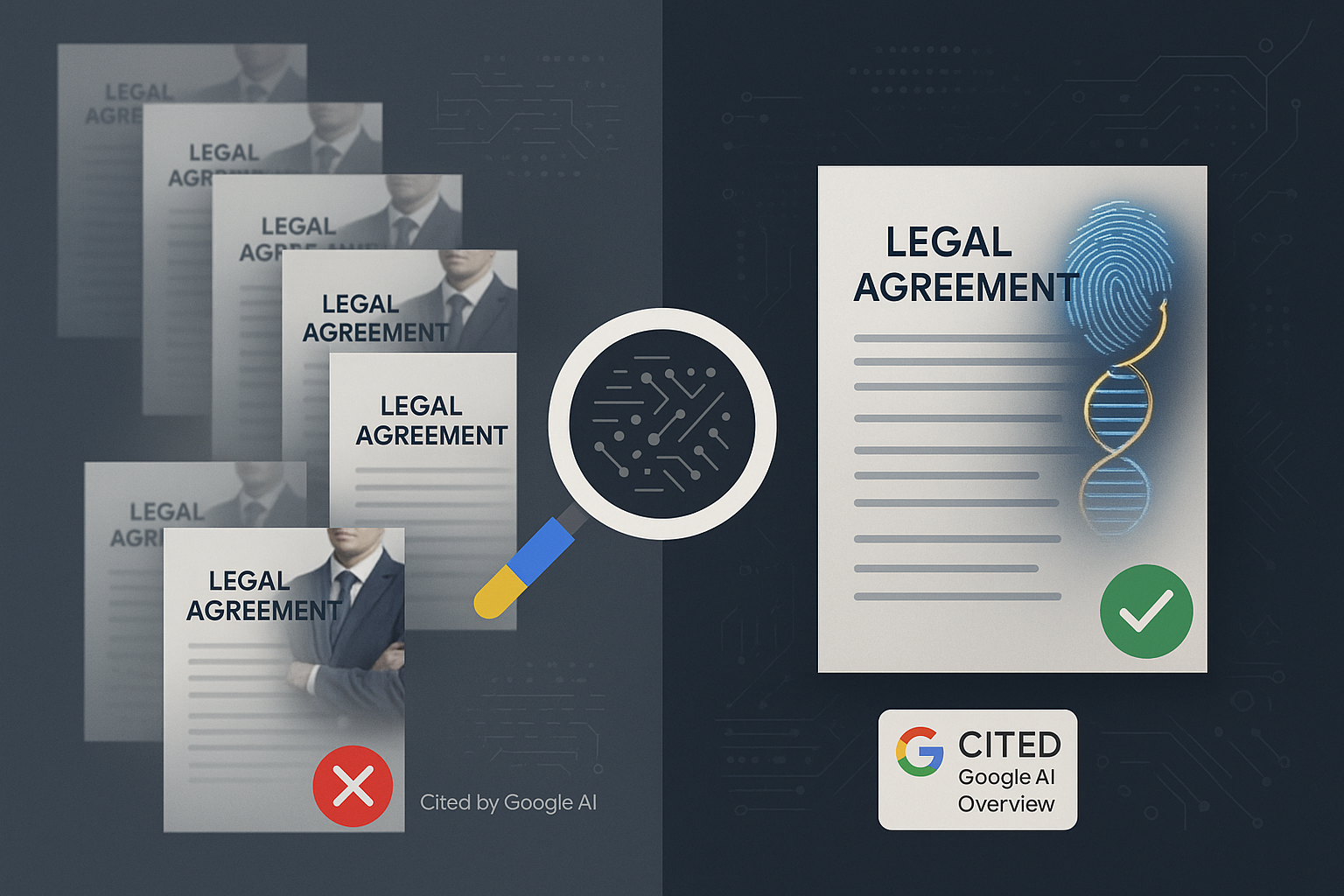
Let me show you two paragraphs about estate planning. Both are optimized for the same keywords. Both mention Texas law. Both have proper schema markup. One will get cited in Google’s AI Overview. The other will be ignored.
Version A: “Estate planning is an important legal process that helps families protect their assets and ensure their wishes are carried out. In Texas, having a comprehensive estate plan can provide peace of mind and avoid potential complications. Our experienced attorneys can help you navigate the complex world of estate planning with personalized solutions tailored to your unique needs.”
Version B: “Most people wait until a health crisis to think about estate planning, which is exactly when clear thinking becomes hardest. I’ve sat across from families in my Austin office trying to make impossible decisions because someone waited too long. Texas is a community property state, which means your estate planning needs are different from what you’d face in California or New York. That’s not a detail. It fundamentally changes how we structure your plan.”
If you can’t tell which one was written by an actual attorney, Google’s AI absolutely can.
What Google’s Systems Actually Detect
When Google evaluates content for its AI Overviews, it’s not just counting keywords or checking for proper legal terminology. The algorithms are analyzing patterns that indicate genuine expertise versus content mill output.
They’re looking for things like:
- How you explain complex concepts (do you use the kind of analogies someone with real experience would use?)
- Whether you acknowledge jurisdictional nuances (or just regurgitate generic legal principles)
- How you address client concerns (are you anticipating real questions or covering SEO keywords?)
- Your reasoning structure (does it follow how lawyers actually think, or how content writers think lawyers think?)
Version A sounds like it was written by someone who read a blog post about estate planning. Version B sounds like it was written by someone who’s actually practiced estate planning in Texas for years.
That difference matters more in 2026 than it ever has before.
The Generic Content Problem
Here’s what’s happening across thousands of law firm websites right now: agencies are using AI tools to pump out “local” content by swapping city names into templates and running legal terms through ChatGPT.
The result reads like every other law firm’s content. Same structure. Same phrases. Same vague expertise claims. Same hollow promises about “personalized service” and “experienced attorneys.”
Google’s AI systems have analyzed millions of legal documents, actual attorney writing, published case materials, and legitimate legal expertise. When you feed them generic content written by someone who’s never practiced law, they know.
And when they know, they don’t cite you. They don’t feature you. They don’t treat your content as authoritative. You get filtered out.
Why Most Agencies Can’t Fix This
The problem isn’t that agencies don’t know SEO. Most of them understand keywords, backlinks, technical optimization, and content calendars perfectly well.
The problem is they’re not lawyers. They can’t write like lawyers because they don’t think like lawyers. They can’t capture jurisdictional expertise because they don’t have it. They can’t replicate how an experienced attorney explains a complex concept to a worried client because they’ve never done it.
So they do what they can: they create clean, optimized, grammatically correct content that checks all the technical SEO boxes while sounding exactly like content that was created to check SEO boxes.
How Voice DNA Changes This
We built Voice DNA because we kept seeing the same problem: great attorneys with websites full of content that didn’t sound like them at all.
Instead of guessing what makes attorney writing authentic, we analyze it. We look at how you actually communicate. Your sentence patterns, your reasoning style, how you build arguments, how you address client concerns, the analogies you naturally use, your approach to explaining complexity.
Then we use that analysis to create content that genuinely reads like you wrote it. Not “in your style.” Not “inspired by your voice.” Content that replicates your actual communication patterns because it’s built on your writing DNA.
The difference shows up immediately. Attorneys read their own content and say “yeah, that sounds like me.” More importantly, their clients read it and think “this person actually knows what they’re talking about.”
And Google’s AI systems? They evaluate it as authentic attorney expertise, because that’s what it is.
What This Actually Achieves
The business outcomes of authentic content versus generic content are stark:
Law firms using Voice DNA-generated content are getting cited in AI Overviews at significantly higher rates than firms using standard agency content. When potential clients see your firm’s name featured in Google’s AI answer, that’s not just visibility. It’s implied endorsement.
The content passes bar compliance review because it reads like an attorney wrote it, not a content mill. It builds actual trust with potential clients because it demonstrates real expertise, not SEO optimization masquerading as knowledge.
And critically, it can’t be easily replicated. Your competitors can hire the same SEO agencies you can. They can target the same keywords. They can copy your technical optimization. But they can’t copy your communication DNA, because it’s yours.
The Competitive Window Is Closing
Right now, most law firms are still playing the old game. They’re paying agencies to create content that sounds like every other firm’s content, wondering why their AI Overview citations are declining and their organic traffic is compressing.
The firms that figure this out in early 2026 will own their markets by mid-year. The firms that wait will be competing for scraps while their competitors get quoted in every relevant AI Overview search.
Because here’s the thing: Google can tell your content wasn’t written by a lawyer. Your potential clients can tell. And increasingly, that’s the only thing that matters.
The question is whether you’re going to keep paying for generic content that gets ignored, or invest in authentic content that gets cited.
